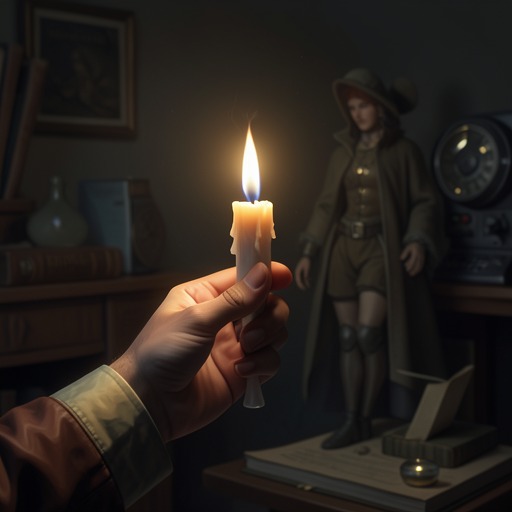
A candle burned on the table
Doctor Zhivago“A candle burned on the table” is the refrain of Yurii Zhivago’s “Winter Night,” but it also reaches beyond the poem into the novel’s account of his life. At Yurii’s funeral, Larisa Feodorovna Antipova remembers a candle on a windowsill during an earlier Christmas conversation and wonders whether that same light, seen from the street by Yurii as he passed, began the fatal sequence that brought them together. The phrase binds lyric recurrence to remembered circumstance, making the candle at once an image in a poem and a hinge in the story’s account of chance, love, and loss.
The phrase in “Winter Night”
The poem places the candle against a blizzard that seems to occupy the whole world. Snow falls and sweeps from end to end; wind sculpts arrows and whorls on the glass; shadows distort in the storm-darkened room. Against that surrounding movement and obscurity, the repeated statement that a candle burned on the table is spare and stable. Its return interrupts the snowbound description without stopping it: the weather keeps pressing in, while the candle’s continued presence gives the poem a fixed point.
The refrain recurs as the poem moves through its images, including the moment when a corner draft flutters the flame. That detail makes the light vulnerable, subject to the very air that enters the room, but not simply extinguished. The repeated line holds this tension between exposure and persistence. It does not cancel the blizzard or promise safety; instead, its returns measure the storm’s passage and keep the small interior flame in view.
A remembered Christmas and the funeral
At Yurii’s funeral, Larisa recalls that the earlier conversation took place at Christmastime, in the same room, lit only by a candle. She remembers that she had gone there intending to shoot what she calls a caricature of vulgarity, and that Pavel Pavlovich Antipov was still a boy. Yurii had not yet entered her life. Yet her memory cannot recover the conversation itself: what remains is the candle burning on the windowsill and the round patch it melted in the icy crust on the glass. A specific mark of warmth on frozen glass survives where the words have vanished.
The funeral gives the remembered light a second, painful meaning. Larisa wonders whether she could have known that Yurii, whose dead body lies on the table before her, had seen the candle from the street while driving past. The novel presents this connection as her wondering, not as a certainty she can verify. Still, the thought makes the remembered sight seem like the beginning of a fatal course: a light in a window, noticed by chance, becomes the point at which the lives of Larisa and Yurii may have started to converge.
Repetition, chance, and parting
The phrase therefore works across two different kinds of repetition. In the poem, it returns openly, interrupting descriptions of snow and wind. In Larisa’s recollection, the candle returns belatedly, as an image retained after the conversation has disappeared from memory. The poem’s formal refrain and the funeral’s act of remembering reinforce one another: what cannot be recovered as a complete past can still recur as a vivid fragment.
That recurrence does not make the past reversible. The candle cannot restore the Christmas conversation or change the fact that Yurii is dead. At the funeral, Larisa thinks that a church service would have suited him, and wishes for the right and occasion to weep freely over him. She feels that, with Yurii’s help, she might briefly break out of the sorrows imprisoning her and recover the joy of liberation she associates with his presence. As the crowd moves out of the room and leaves her alone, the candle image stands between connection and separation: it joins the first remembered glimpse to the final leave-taking, while confirming that the light can be recalled but the life it illuminated cannot be returned.